
Automatic filling
Configured tank thresholds initiate the refill workflow so operators do not have to manually switch pumps.
AquaFlow automates tanks, valves and pumps from a single tank to a campus-scale site — while keeping protection and operating decisions close to the equipment.

Trigger a refill demand and follow the same disciplined sequence a professional automation system should communicate: detect, verify, actuate, confirm, authorize, monitor and shut down. Then try to break it.
Tank reports refill threshold.
Local rules evaluate the route.
Actuation is requested.
Positive feedback required.
Only after confirmation.
Fill continues under supervision.
Pump off → valve close.
Every function has a practical job: automate filling, protect equipment, reduce waste, expose consumption and make the site visible without turning it into a complicated control room.
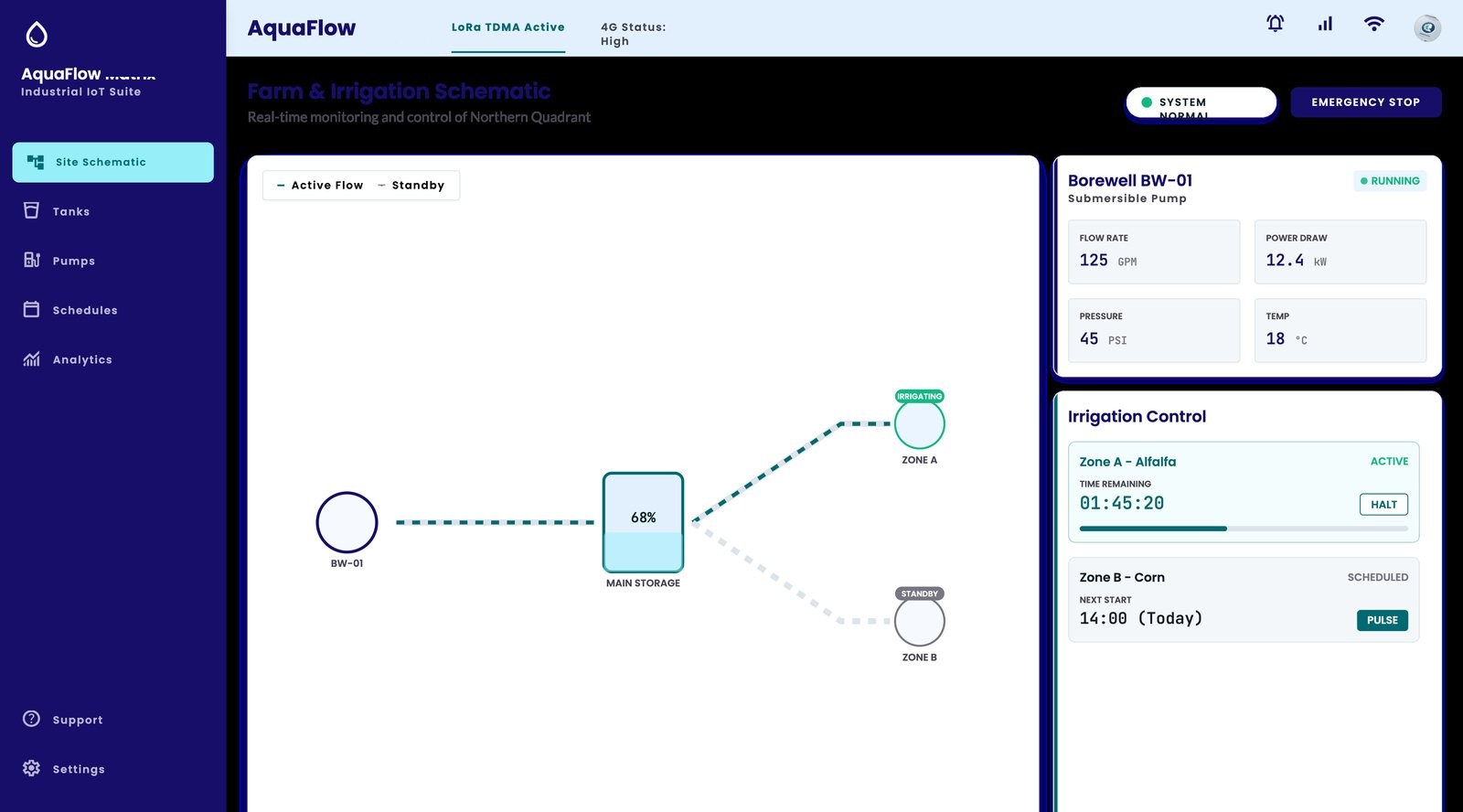
Know what is happening at the site. Live flow, pump condition and storage level can be read from one operational view.
Find abnormal behaviour before it becomes a bigger problem. Leak, high-flow and equipment alerts stay visible in context.
Configured tank thresholds initiate the refill workflow so operators do not have to manually switch pumps.
Dry-run, overload, voltage, phase and overheating protection form part of the operating concept.
Target levels stop unnecessary pump runtime and help reduce avoidable water loss.
Per-tank and time-based usage views help identify abnormal consumption and possible leaks.
Optional TDS, turbidity and temperature sensing can be integrated where the application requires it.
Levels, pump state and alerts are available from the app and dashboard wherever the site is.
The mobile experience uses the actual AquaFlow product screens. Each one communicates a specific operating task.
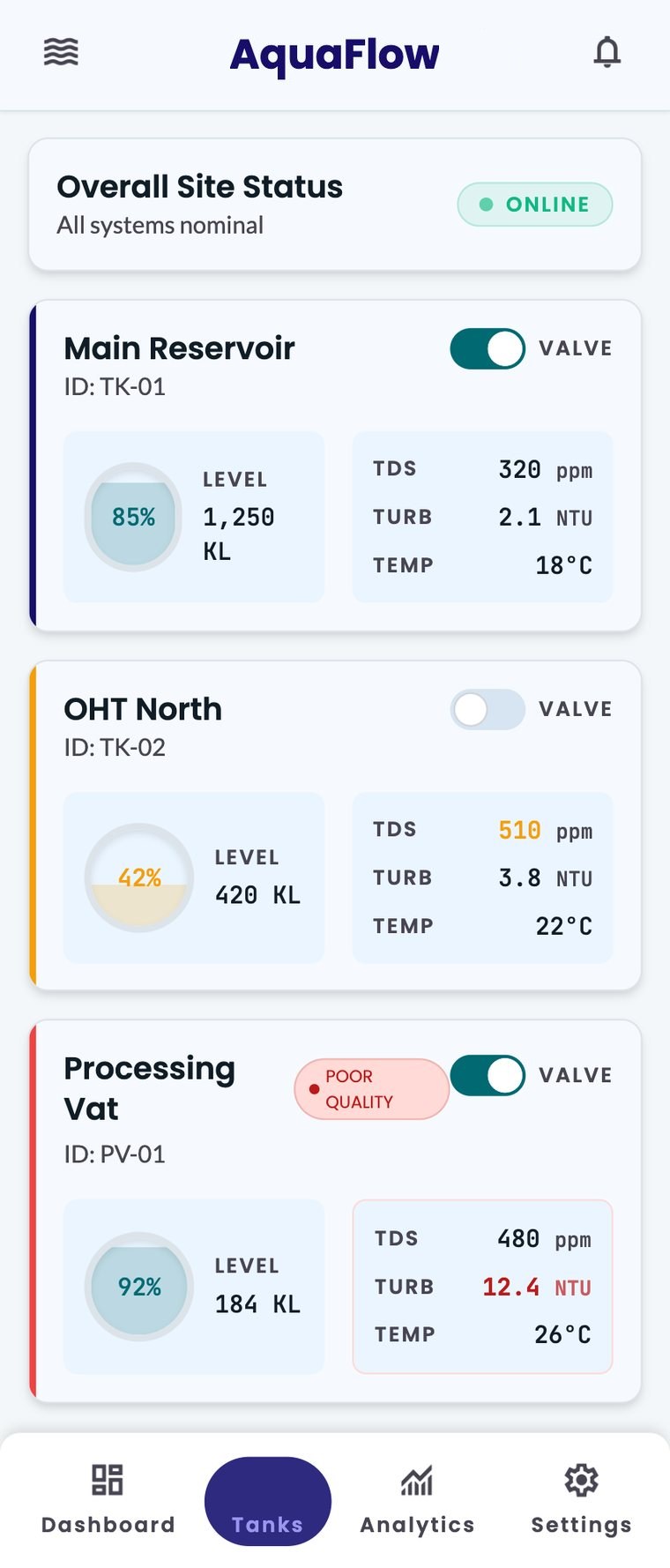
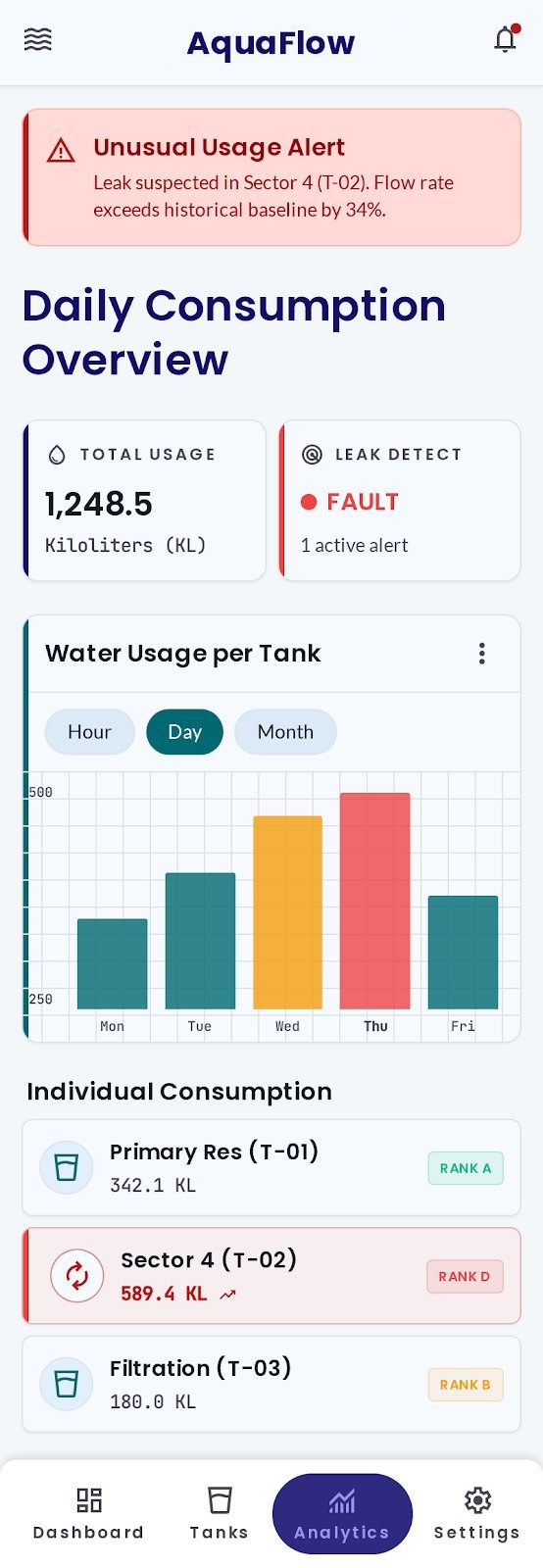
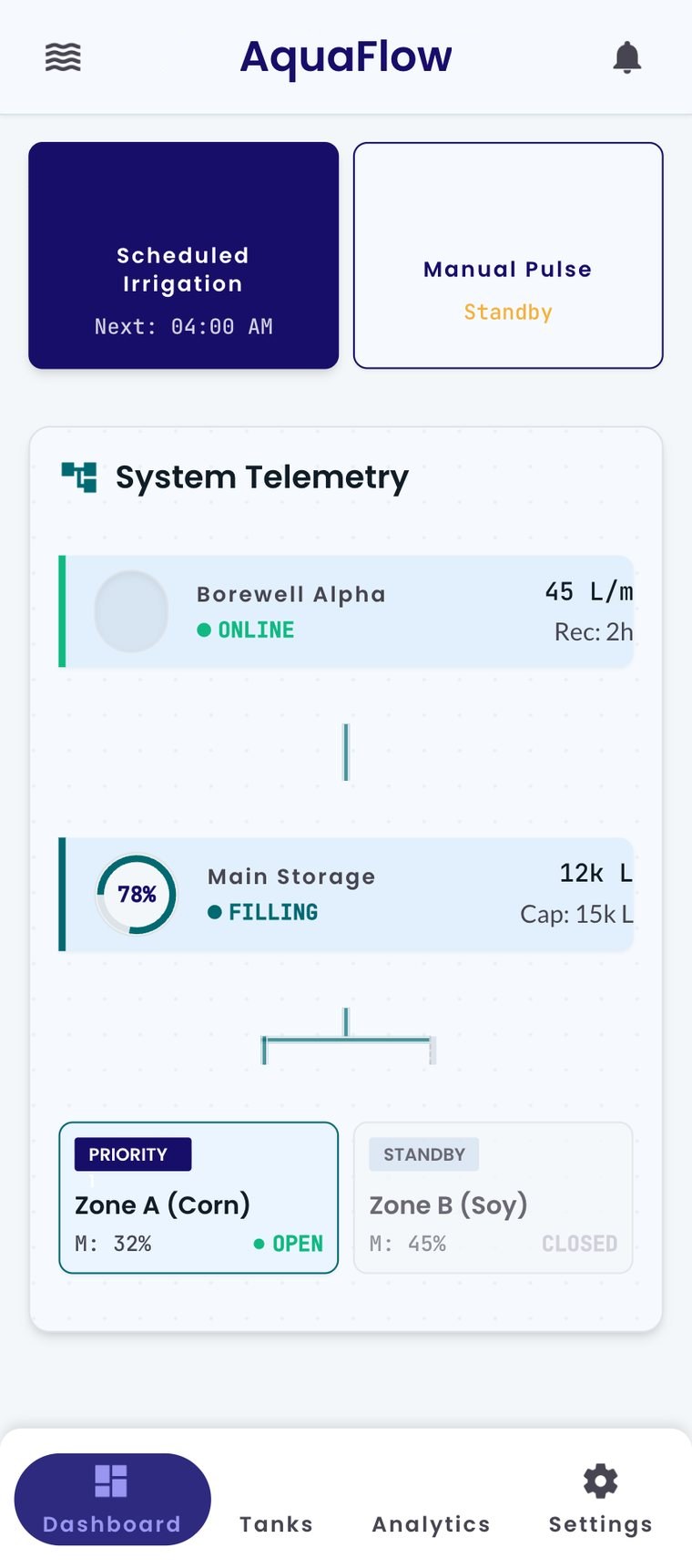
Move from a live schematic into consumption analysis, alert context and tank-by-tank comparison.
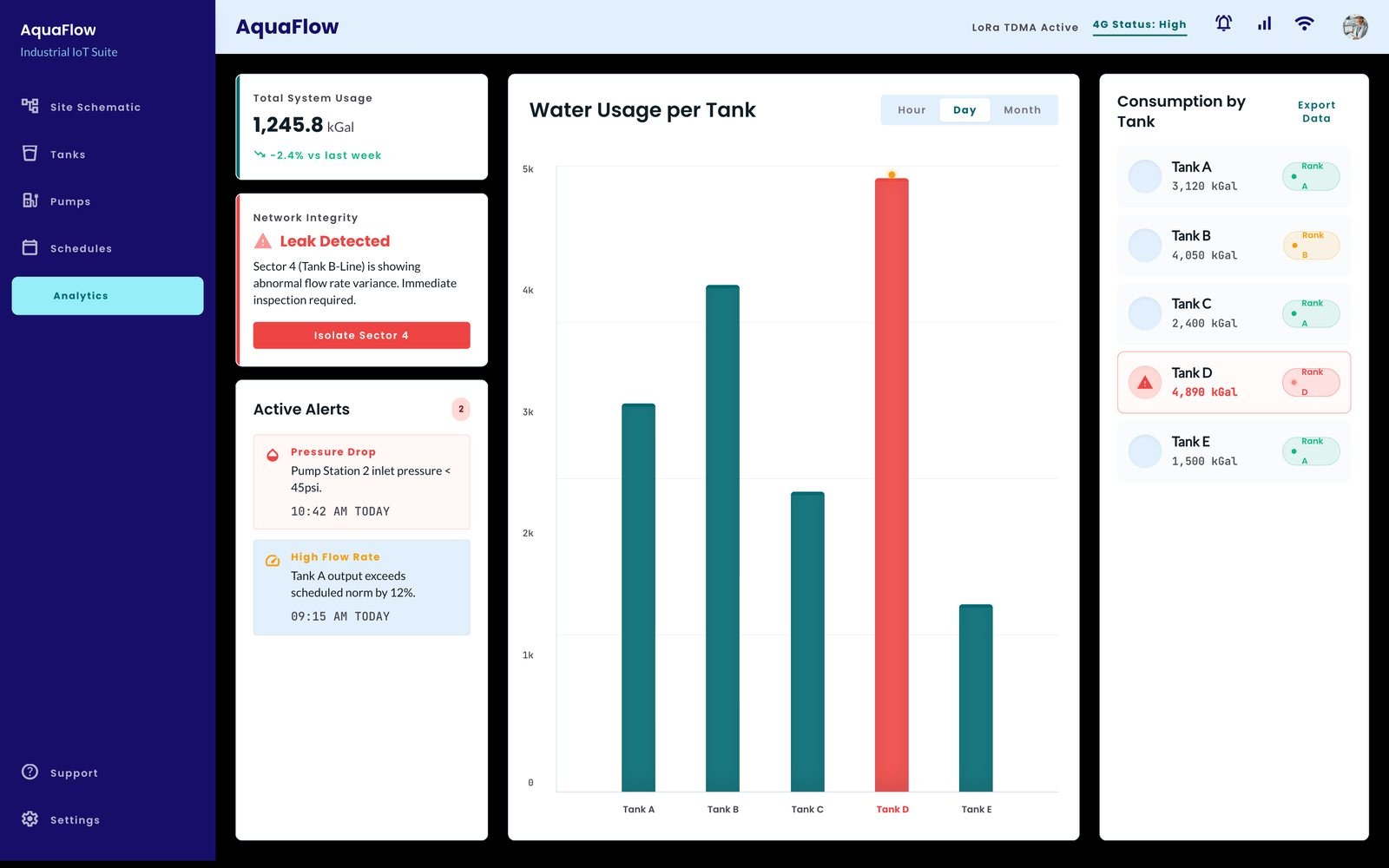
Compare consumption across the site and isolate abnormal tanks.
Watch active alerts, total usage and ranked tank performance from the same platform.
Each unit has one job. Use the ones a site needs, and add capacity as it grows.
The brain of the installation, one per site. Holds your configuration, decides which pump fills which tank and in what order, keeps a full history, and is what your app talks to.
Measures the water level in a tank — overhead, underground sump, open well or borewell. It only measures and reports; it never controls anything.
Opens and closes one motorised valve on command, and reports back that it actually moved. A valve that is stuck is detected, not silently assumed to have worked.
A Tank Node and a Valve Node in one unit where a site needs both a level reading and a valve at the same location.
Adds direct control of a small pump (up to 1 HP, single-phase) to a Combo unit, for simple sites such as a borewell feeding a single small tank.
The dedicated protection unit for any pump, of any size, single- or three-phase. It watches current, voltage and phase — and on higher tiers, motor temperature and vibration trend.
Combo-P switches the pump's power directly, which is why we cap it at small, single-phase motors with their own built-in thermal protection. Pump Guard never switches motor power — it closes the control coil of your existing starter, with your starter's overload relay always in the circuit. That is what lets Pump Guard protect a motor of any size.
AquaFlow is designed to scale from a single installation to multiple tanks and zones, with the site presented as a coherent system rather than disconnected devices.
The system separates fallback, local protection, operating rules and cloud visibility so the most important protections do not depend on a single network path.
AquaFlow never switches motor power directly for a protection unit. It closes and opens the control coil of your existing motor starter, with your starter's overload relay always left in the circuit.
The app never starts or stops a pump. It can request a fill; the controller and the protection unit decide, and can refuse. This is not a current limitation — it is a permanent design rule.
The same platform across storage, pumping, irrigation, analytics and alert-driven operations.
Monitor main reservoirs, overhead tanks and processing points with level, water-quality and valve status in one view.
SEEN IN: MOBILE TANKS + HOME DASHBOARDTrack usage by tank, compare historical behaviour and surface unusual consumption or suspected leaks.
SEEN IN: USAGE + ANALYTICSKeep pump condition, flow and temperature visible alongside overall site status.
SEEN IN: SCHEMATIC DASHBOARDCombine scheduled irrigation, manual pulses and live zone telemetry with a site-level schematic.
SEEN IN: SCHEDULE + SCHEMATICKeep anomalies in context with alerts for leakage, high flow and water-quality conditions.
SEEN IN: MOBILE USAGE + ANALYTICSMove from individual equipment to overall site status, consumption performance and exception management.
SEEN IN: DASHBOARD ANALYTICSApproximate answers are fine. Share the site basics and GIZMO can understand the tanks, pumps, storage and automation level involved.